What should a fleet owner do when adding a used truck with unknown service history?
No records means you set the baseline yourself. Here is a first-thirty-days plan that turns a mystery vehicle into one you can schedule, budget, and trust, starting before the money changes hands.
Before the money changes hands
Pay for an independent pre-purchase inspection at a shop that has no stake in the sale, and have them scan for stored and pending fault codes and check emissions readiness monitors. Codes that were recently cleared show up as monitors not ready, and that pattern on a truck being sold is a reason to ask hard questions. Pull a vehicle history report on the VIN for title brands, reported accidents, and odometer inconsistencies, and run the VIN through the free federal recall lookup so you know what open campaigns come with the truck. Ask for whatever records exist; fleet auction vehicles often come with partial histories, and even a stack of oil change receipts tells you something. Related: What is the best way to log service history for every fleet vehicle?
On a diesel, confirm the emissions system is intact and functioning. A truck with its diesel particulate filter or exhaust fluid system removed or defeated is a problem on several fronts: tampering with those systems is illegal under federal clean air law, operating a tampered truck violates many state rules and fails inspection where emissions testing applies, the truck is hard to resell, and the cost to restore the system can exceed the discount you got. Test drive it loaded if you can, listen for driveline noise under torque, check that the transmission shifts cleanly warm and cold, and look for fresh undercoating or paint on the frame that may be hiding rust or repairs. Related: Which inspections should a small fleet run before every long haul trip?
Keep reading: How do you schedule preventive maintenance by mileage across a small vehicle fleet?, What is the best way to log service history for every fleet vehicle?, Why does preventive maintenance save more money than waiting for breakdowns?. See how FleetTendr helps you preventive fleet maintenance scheduling and logs.
Reset the clock with baseline services on day one
With no history, assume nothing was done. Change the engine oil and filter, the fuel filters, the air filter, and the cabin filter. Test the coolant and replace it if the type or age is unknown. Check the transmission fluid condition and follow the manufacturer's guidance on service; on a high-mileage unit with no records, a drain and fill is often the safer choice over an aggressive flush, but the manual for that transmission is the authority. Service the differentials and transfer case, replace the brake fluid, and load test the battery. Inspect belts and hoses, and if the engine uses a timing belt and there is no proof it was replaced, treat it as due. Related: When should you schedule an oil change based on mileage or time?
Measure and record the state of the wear items: brake pad and rotor thickness at every corner, tread depth at every tire position, tire date codes, and any play in ball joints, tie rods, and wheel bearings. Write down the odometer and, if the truck has one, the engine hours on the day you do all of this. That reading is now the origin for every interval on this vehicle. It is also the date you attach the inspection photos and the baseline work order to, so anyone who looks at the record later understands where the known history begins.
Look hard for the expensive problems
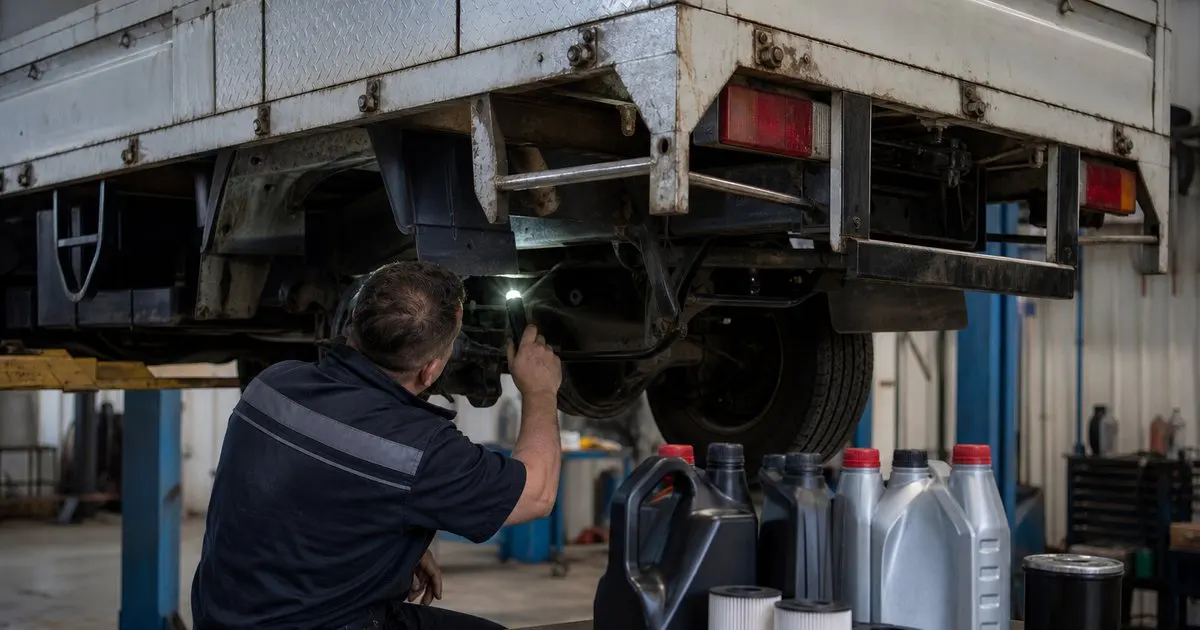
Get the truck on a lift and go slowly. Frame rails and crossmembers for rust scaling and cracks, especially on anything that lived in a state that salts roads. Brake lines and fuel lines for corrosion. Leaks at the rear main seal, oil pan, transmission pan, and axle seals, and note whether they are seeps or drips. The exhaust and aftertreatment system for damage and prior repairs. Wiring harnesses along the frame and around any upfit for chafing, bad splices, and tape repairs, which are a common source of intermittent faults on used work trucks. Body mounts, spring hangers, and the condition of any liftgate, rack, or PTO that came with the vehicle.
Photograph everything, including the good parts, and file it with the baseline work order. This is the day-zero record for the vehicle. Six months from now, when a leak appears or a customer claims your truck damaged their driveway, those photos settle the question of what was already there. It is also the moment to fix or budget the items you found: sort them into safety now, mechanical soon, and cosmetic whenever, and put the first two on the schedule with dates.
Put it on the schedule and watch it for the first quarter
Enter the truck in your maintenance system with the acquisition date, purchase price, VIN, baseline odometer, and any remaining transferable warranty, then apply your standard preventive plan with one adjustment: make the first interval shorter. Sending an oil sample from the first change to a lab is inexpensive and tells you whether coolant, fuel, or metal is showing up in the oil, which no visual inspection can. Assign a driver, put the truck on the weekly walkaround with a defect form, and tell that driver plainly that the vehicle is under observation and every noise matters. Related: How do you schedule preventive maintenance by mileage across a small vehicle fleet?
Track repair spending on the new unit separately for its first ninety days. A used truck that immediately generates a string of unrelated repairs is telling you what its previous life was like, and it is better to make the keep-or-sell decision early than after a year of chasing problems. Handle the paperwork in the same window: title, registration, insurance, any state or annual commercial inspection required for its weight class, and the registered address for recall notices. In FleetTendr we ask for the baseline odometer and the acquisition date on the first screen precisely so the intervals start from a real number instead of a guess.
- Before buying, get an independent inspection, scan for cleared codes, pull the VIN history and open recalls, and confirm a diesel's emissions system is intact.
- On day one, perform every fluid and filter service as if none had ever been done, and record the baseline odometer and hours as the origin for all intervals.
- Inspect frame, lines, seals, wiring, and upfit equipment on a lift, photograph everything, and sort findings into safety now, mechanical soon, and cosmetic later.
- Use a shortened first interval with an oil analysis, assign a driver to weekly walkarounds, and track first-quarter repair spend to decide early whether the truck stays.

Julien Jimenez
Julien Jimenez is an independent software builder based in Paris. He designs, ships, and operates focused SaaS products for small businesses and independent professionals. Read the full author page.
Service Every Vehicle On Time
Preventive fleet maintenance scheduling and logs. FleetTendr is built to help you put this into practice.
Start free trialMore from the FleetTendr blog

How do you schedule preventive maintenance by mileage across a small vehicle fleet?

What is the best way to log service history for every fleet vehicle?
Why does preventive maintenance save more money than waiting for breakdowns?
Get the FleetTendr playbook
Practical guides on fleet maintenance software, straight to your inbox as we publish them. No spam, unsubscribe any time.