Which tire wear patterns should a fleet manager watch for during weekly walkarounds?
Tires tell you about pressure habits, alignment, and suspension months before a blowout does. Here is how to read them in two minutes per vehicle and what each pattern means for the work order.
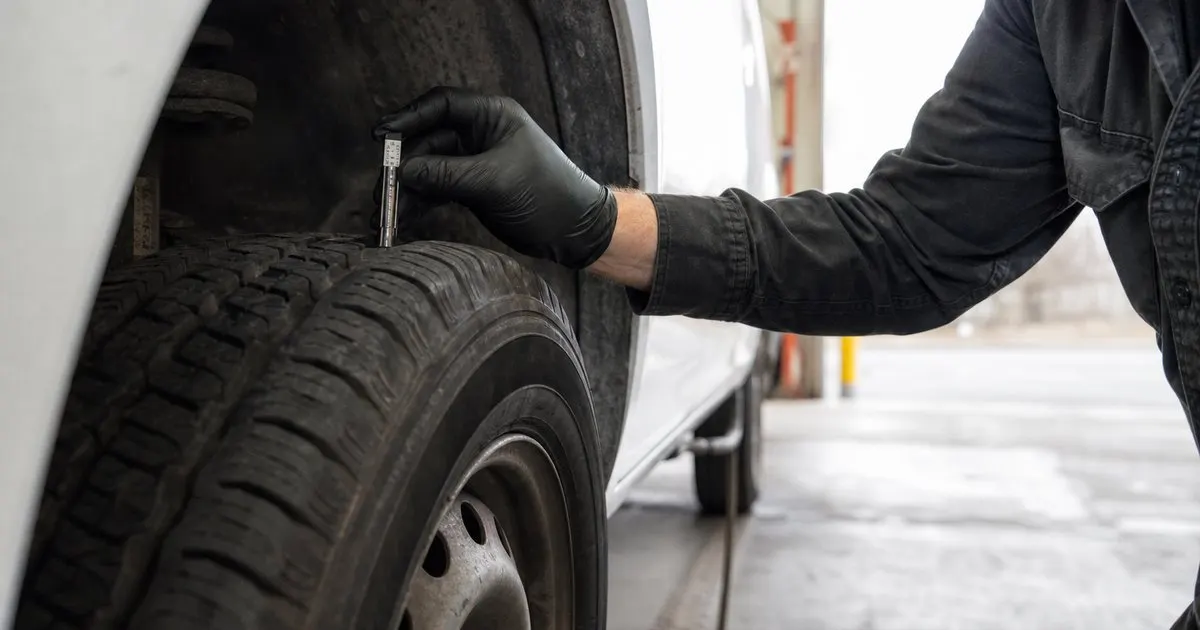
Center wear and shoulder wear tell a pressure story
Run a hand across the tread. If the center rib is worn noticeably more than the edges, the tire has been running overinflated, riding on its crown. If both outer shoulders are worn and the center is fresh, it has been underinflated, flexing on its edges. Underinflation is by far the more common of the two in fleets, because tires lose a little pressure every month, they lose more when temperatures drop, and nobody is checking. It also runs hotter, burns more fuel, and is the usual setup for a highway blowout on a loaded van. Related: Why does preventive maintenance save more money than waiting for breakdowns?
The fix is boring and effective: check pressure on a fixed rhythm, weekly for most fleets or at every fuel-up for high-mileage units, and inflate to the placard pressure on the door jamb for the load being carried, not the maximum molded into the sidewall. For pickups and vans that run heavy, the correct pressure depends on the load, so a vehicle that alternates between empty and fully loaded may need a pressure note in its record. Write the readings down. A tire that needs air every week has a slow leak, a bad valve stem, or a cracked wheel, and that is a repair, not a top-off. Related: Which inspections should a small fleet run before every long haul trip?
Keep reading: How do you schedule preventive maintenance by mileage across a small vehicle fleet?, What is the best way to log service history for every fleet vehicle?, Why does preventive maintenance save more money than waiting for breakdowns?. See how FleetTendr helps you preventive fleet maintenance scheduling and logs.
One-sided wear, feathering, and cupping point at alignment and suspension
Wear concentrated on only the inner or only the outer edge of a single tire means the wheel is tilted, which comes from camber out of spec, a worn ball joint or control arm bushing, a sagging spring on that corner, or a bent component after a curb or pothole strike. Feathering is a saw-tooth edge across the tread blocks that you can feel more than see: smooth in one direction, sharp in the other. That is a toe problem, the wheels pointing slightly toward or away from each other, and it scrubs rubber off fast. Cupping or scalloping, a pattern of alternating dips around the circumference, usually means worn shocks or struts letting the tire bounce, or a wheel that is out of balance.
Work vans and pickups drift out of alignment more than passenger cars because they carry heavy racks and shelving, get loaded unevenly, and spend their lives on the roughest streets in the service area. Schedule an alignment check whenever feathering or edge wear appears, after any suspension or steering repair, and after a hard impact even if the vehicle drives straight. Replacing a feathered tire without fixing the toe just buys the same wear pattern on a new tire.
Tread depth, sidewall condition, and tire age
Measure tread depth with a gauge, in three spots across the tread and at a couple of points around the circumference, because an average hides the shoulder that is about to go bald. For commercial motor vehicles, federal rules set minimums of 4/32 of an inch on steer tires and 2/32 of an inch on other positions; most fleets set their own replacement threshold above those floors because wet-road traction falls off well before the legal limit, and because a tire that is at the limit on Monday is under it by Friday on a busy van. Record the measurement per position, not just per vehicle.
Look at sidewalls for cracking, bulges, and cuts, and check the DOT code for the tire's age. The last four digits of that code are the week and year of manufacture. Tires can look fine and still be too old to trust, especially on trailers, spares, and low-mileage units that sit in the sun. The spare is the tire everyone forgets: check its pressure and age too, because it is the one you will need at the worst possible moment.
Turning what you see into a rotation and replacement plan
The weekly walkaround is where patterns get noticed; the periodic service is where they get measured and logged. Record tread depth by position at every service and you will be able to see the wear rate per tire, project when each one reaches your threshold, and buy tires on a schedule instead of in a panic. Rotate following the pattern the vehicle manufacturer specifies for that drivetrain, and on dual-wheel trucks keep matched pairs together, since a mismatched dual overloads the larger tire. Related: What is the best way to log service history for every fleet vehicle?
Tires are one of the larger maintenance line items for most small fleets, so the accounting matters. Track tire cost per vehicle alongside the wear notes, and you will quickly see which vehicles, routes, or drivers are eating tires, which is often the first hint of an alignment problem or a driver who corners hard. In FleetTendr we treat tread depth as a measurement you log per position so the trend is visible, but a well-kept sheet in the vehicle folder does the same job if someone actually fills it in. The habit is the tool. Related: How do you schedule preventive maintenance by mileage across a small vehicle fleet?
- Worn center means overinflation, worn shoulders mean underinflation, and underinflation is the common one; check pressure weekly against the door placard.
- Edge wear on one tire, feathering, and cupping point to alignment, suspension, or balance problems that a new tire will not fix.
- Measure tread depth in several spots per tire, log it by position, and set a replacement threshold above the legal minimums.
- Check sidewalls and DOT date codes, including the spare, and use logged wear rates to buy and rotate tires on a schedule.

Julien Jimenez
Julien Jimenez is an independent software builder based in Paris. He designs, ships, and operates focused SaaS products for small businesses and independent professionals. Read the full author page.
Service Every Vehicle On Time
Preventive fleet maintenance scheduling and logs. FleetTendr is built to help you put this into practice.
Start free trialMore from the FleetTendr blog

How do you schedule preventive maintenance by mileage across a small vehicle fleet?

What is the best way to log service history for every fleet vehicle?

Why does preventive maintenance save more money than waiting for breakdowns?
Get the FleetTendr playbook
Practical guides on fleet maintenance software, straight to your inbox as we publish them. No spam, unsubscribe any time.