Why does a maintenance spreadsheet fall apart once a fleet passes ten vehicles?
The spreadsheet was perfect with four trucks. Here is what changes as the fleet grows, why the failures are about process rather than formulas, and what to do whether or not you buy software.
The interval math grows faster than the fleet
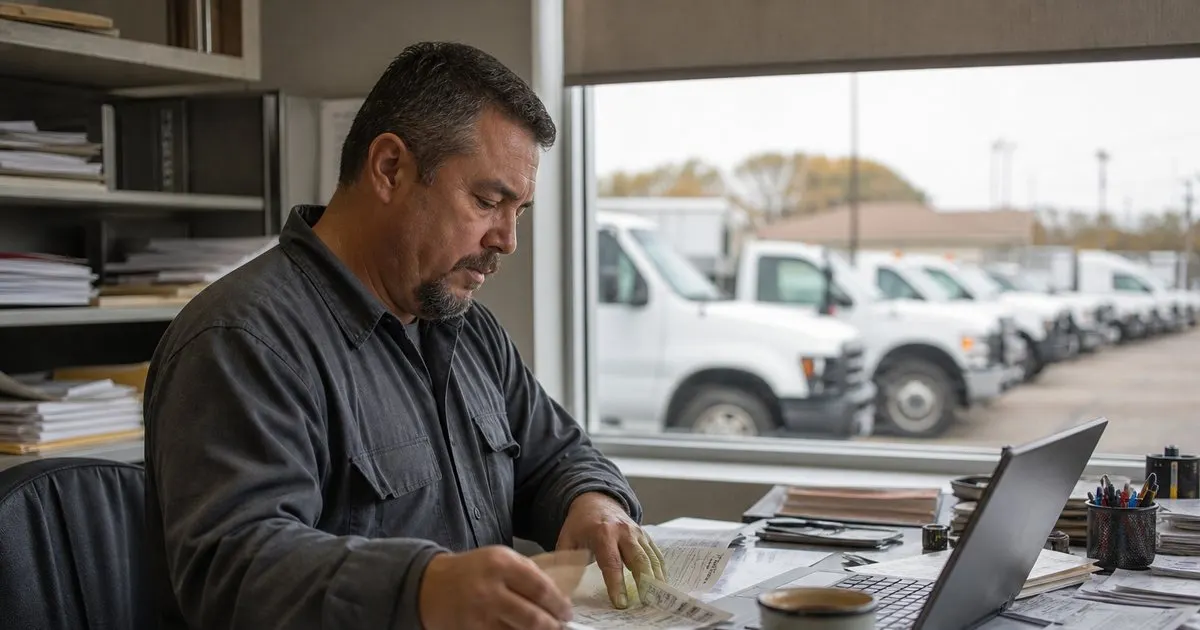
With four vehicles and three tracked services, you are watching twelve due points, and you can hold most of them in your head. With twelve vehicles and eight service types (engine oil, tires, brakes, coolant, transmission, belts and hoses, annual inspection, registration), you are watching close to a hundred rolling due points. Each one has to be recalculated whenever the service is performed, and each depends on a current odometer reading that someone has to collect and type in. A formula that says next due equals last done plus interval is trivial. Keeping the 'last done' cell accurate on a hundred rows is not.
The failure is rarely a broken formula. It is a stale input. The oil change was done on Tuesday but the cell still shows the March date because the invoice sat in a truck's glove box. The odometer column was last updated three weeks ago, so the sheet says a van is 800 miles from its next service when it is already past it. Every row is only as accurate as the least recent update, and as the fleet grows, the gap between what the sheet says and what is true widens until nobody trusts it and everyone goes back to guessing. Related: When should you schedule an oil change based on mileage or time?
Keep reading: How do you schedule preventive maintenance by mileage across a small vehicle fleet?, What is the best way to log service history for every fleet vehicle?, Why does preventive maintenance save more money than waiting for breakdowns?. See how FleetTendr helps you preventive fleet maintenance scheduling and logs.
One file cannot serve the shop, the office, and the drivers at once
A spreadsheet has one author at a time. In practice the owner keeps it, the shop tells the owner what they did, the office pays the invoice, and the driver knows the truck is making a noise. Each of those people has something the sheet needs, and none of them can put it in directly. So it gets emailed, and now there are three versions with different file names, and someone overwrites a column while sorting. There is no record of who changed what, and a receipt, a photo of a cracked leaf spring, or a scanned inspection form has nowhere to live inside a cell.
Drivers are the biggest loss. They see the vehicle every day, but their reports arrive as texts and voicemails, which someone then has to transcribe, and most never make it in. The history of the vehicle ends up scattered across a spreadsheet, an inbox, a text thread, and a folder of paper invoices, and reconstructing it takes an afternoon. At four vehicles that afternoon happens rarely. At twelve it happens every time something goes wrong.
The questions a growing fleet needs answered quickly
Which vehicles are overdue right now? What did truck seven cost us in repairs over the last twelve months? Which part have we replaced twice on the same van? Which vehicle has spent the most days out of service? Is that transmission still under warranty? A skilled spreadsheet user can answer some of these with pivot tables and lookups, but those are fragile, they break when someone inserts a column, and they depend on the same stale inputs. Most owners stop asking the questions because the answer takes too long, and decisions about replacement, vendor performance, and budgets get made on gut feel.
There is also the compliance moment. A roadside inspection, an insurance audit, or a customer's safety questionnaire can require producing the maintenance and inspection history for a specific vehicle on short notice. Pulling that from rows spread across tabs, plus a filing cabinet, is exactly the situation where a missing record becomes expensive. A system that is organized by vehicle, with documents attached, turns that into a five-minute task. Related: How do you schedule preventive maintenance by mileage across a small vehicle fleet?
Fix the process first, then choose the tool
If you are staying on a spreadsheet for now, four changes buy real time. Give the file a single owner and a single location. Set a fixed odometer capture routine, weekly, from fuel logs or a driver text, and enter it the same day. Use one tab per vehicle for history plus a summary tab that only reads from the others, with conditional formatting that turns overdue rows red. Keep a separate work order log with a column for the odometer at service, and store receipts and photos in a folder named for the vehicle. That structure is basically a manual version of what maintenance software does. Related: What is the best way to log service history for every fleet vehicle?
Move to software when someone is spending more than a couple of hours a week keeping the sheet alive, when an overdue item was missed because the sheet was wrong, or when you cannot answer cost per vehicle within five minutes. We built FleetTendr for exactly that transition: rules instead of formulas, a place for each person to enter what they know, and documents attached to the vehicle. Be honest with yourself about one thing, though. Software still needs odometer readings and completed work orders entered. It makes the discipline easier and shares it across people; it does not remove the need for it. Related: Why does preventive maintenance save more money than waiting for breakdowns?
- The spreadsheet does not break on formulas; it breaks on stale inputs, because every due date depends on odometer readings and service dates someone has to keep current.
- A single file cannot take input from the shop, office, and drivers at the same time, so history ends up scattered across texts, invoices, and versions.
- Growing fleets need fast answers on overdue items, cost per vehicle, repeat failures, and downtime, which fragile pivot tables rarely deliver.
- Fix the process with one owner, a weekly odometer routine, and per-vehicle organization, then move to software when the sheet costs hours or misses a service.

Julien Jimenez
Julien Jimenez is an independent software builder based in Paris. He designs, ships, and operates focused SaaS products for small businesses and independent professionals. Read the full author page.
Service Every Vehicle On Time
Preventive fleet maintenance scheduling and logs. FleetTendr is built to help you put this into practice.
Start free trialMore from the FleetTendr blog

How do you schedule preventive maintenance by mileage across a small vehicle fleet?

What is the best way to log service history for every fleet vehicle?
Why does preventive maintenance save more money than waiting for breakdowns?
Get the FleetTendr playbook
Practical guides on fleet maintenance software, straight to your inbox as we publish them. No spam, unsubscribe any time.